

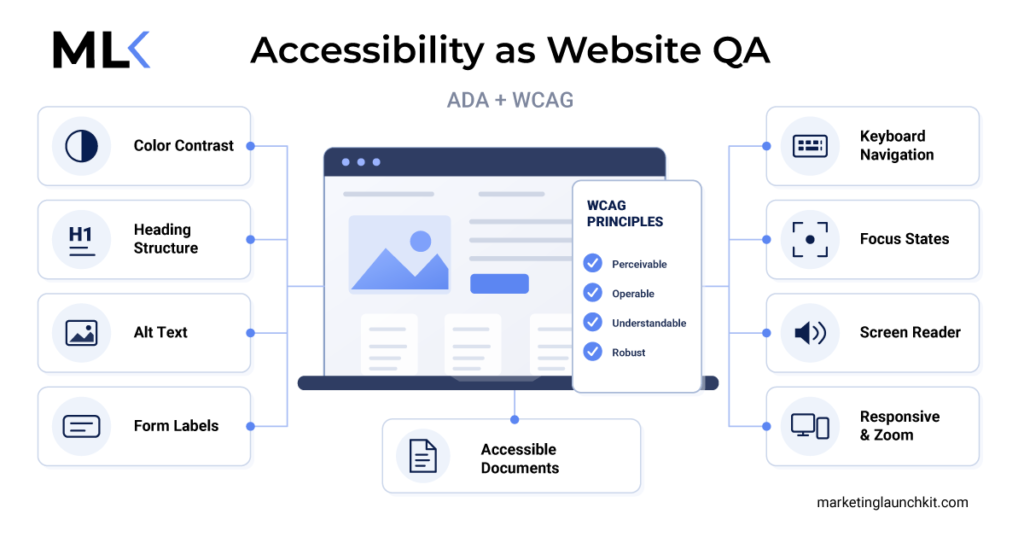
Accessibility is increasingly becoming an explicit technical acceptance requirement for websites. For some organizations, it is legally required. For others, it enters through client requirements or internal standards. Irrespective of where the requirement originates, accessibility shouldn’t be thought of as a last-minute marketing or design adjustment to a company’s website.
The Americans with Disabilities Act (ADA) and Web Content Accessibility Guidelines (WCAG) are two of the most common references organizations encounter when establishing website accessibility requirements.
The process is familiar: establish the requirements, build to them, test the implementation, correct deficiencies, and validate the result. For organizations accustomed to engineering specifications, quality systems, compliance requirements, or other formal acceptance standards, the concept should not be unusual.
Why Website Accessibility Starts Before Testing
Website accessibility testing is a critical part of the website design and development process. Therefore, accessibility needs to be considered before the website project begins, rather than addressed later through remediation.
Many of the decisions that determine whether a website is accessible are made before development even begins:
- Information and heading structure
- Navigation hierarchy
- Color palette and contrast
- Page templates
- Forms and field labels
- Links and calls to action
- Images and alternative text
- Tables and diagrams
- Keyboard navigation and interactive elements
- Responsive behavior
- Downloadable resources
If these components are planned, designed, and implemented with accessibility in mind, testing becomes a validation process rather than a repair project.
This is the same reason quality requirements are easier to satisfy when they are incorporated into the system from the beginning instead of inspected into the finished product afterward.
WCAG Provides Testable Requirements
WCAG is developed and maintained by the World Wide Web Consortium (W3C) through its Web Accessibility Initiative (WAI).
WCAG 2.2 is not subjective design recommendations. It’s a success criteria framework written so that conformance can be evaluated. Some criteria can be checked with automated tools, while others require human evaluation. W3C specifically notes that no automated tool alone can determine whether a website meets accessibility standards.
WCAG 2.2 is the latest version of the standard and provides testable success criteria for evaluating the accessibility of web content. It is not simply a set of subjective design recommendations. Some success criteria can be evaluated with automated tools, while others require human review and judgment.
Automated testing can identify many technical issues, including certain contrast failures, missing attributes, and markup problems, but it cannot determine conformance on its own. Manual evaluation is still needed to assess areas such as keyboard usability, content structure, meaningful links, forms, navigation, interaction behavior, and whether the website functions as intended for users with disabilities.
The objective is not simply to produce a clean automated scan, but to determine whether the implemented website meets the applicable accessibility requirements.
Accessibility Affects Content Publishing
A website may meet applicable accessibility requirements at launch but become less accessible as new content is published. Therefore, content management and publishing workflows are part of the broader accessibility solution.
The staff who maintain a website need usable templates and publishing practices for common tasks such as:
- Adding appropriate headings
- Writing meaningful links
- Applying alternative text to images
- Publishing accessible tables
- Uploading documents
- Keeping page structure intact
- Using branded website components correctly
In addition to HTML content, downloadable documents create another challenge. For example, large collections of historical PDFs may need to be reviewed to determine whether they should stay published, be converted into website content, be remediated for accessibility, or be removed altogether.
Accessibility therefore extends beyond front-end development and testing. It also affects content architecture, governance, document management, CMS configuration, and ongoing publishing workflows.
Accessibility Workflow: Define, Build, Test, Correct, Retest
A useful accessibility workflow should be structured like other technical QA processes within website development:
- Define the applicable standard
- Build accessible patterns
- Test and document issues
- Correct issues
- Retest and validate against the applicable criteria
- Launch the website
- Establish and maintain accessible publishing practices
This is considerably more manageable than treating accessibility as a mysterious parallel discipline. It also helps separate the role of accessibility tools from the actual compliance process. Plugins, scanning software, and automated testing platforms can support the work, but they do not replace robust website architecture, accessible development practices, sound content decisions, or human validation.
W3C’s accessibility testing guidance recommends evaluating accessibility throughout development because problems are easier to address when identified early.
Why Accessibility Requirements are Becoming More Visible
In the modern era, accessibility requirements are becoming more explicit in digital projects.
One recent example is the U.S. Department of Justice’s ADA Title II web accessibility rule for state and local governments, which establishes WCAG 2.1 Level AA as the technical standard for covered web content and mobile applications. Current compliance dates extend into 2027 and 2028 depending on the type and size of the public entity.
Other organizations may encounter accessibility requirements through different legal obligations, contracts, customer standards, organizational policies, or risk management practices.
The same obligations do not apply to every organization. However, the implementation lesson is broadly useful: when accessibility is a requirement, it should be incorporated into the website system rather than tacked on at the end of a finished project.
Accessibility is Part of Building a Website Correctly
Accessibility is not a separate marketing exercise. For organizations with defined requirements, it is another dimension of website quality. That means making good structural decisions, using appropriate technology, giving content teams the right tools, testing against established criteria, resolving defects, and maintaining the system properly after launch.
When accessibility is addressed from the start, compliance becomes part of a disciplined website development process rather than an expensive rework project at the end.
Build Accessibility into Your Website System
Accessibility works best when it is incorporated into website architecture, content, CMS workflows, and quality assurance from the beginning rather than treated as a last minute update.
Marketing Launch Kit provides consulting and implementation solutions for engineering and technical organizations, integrating website architecture, content systems, accessibility, analytics, and technical infrastructure into maintainable digital environments.