

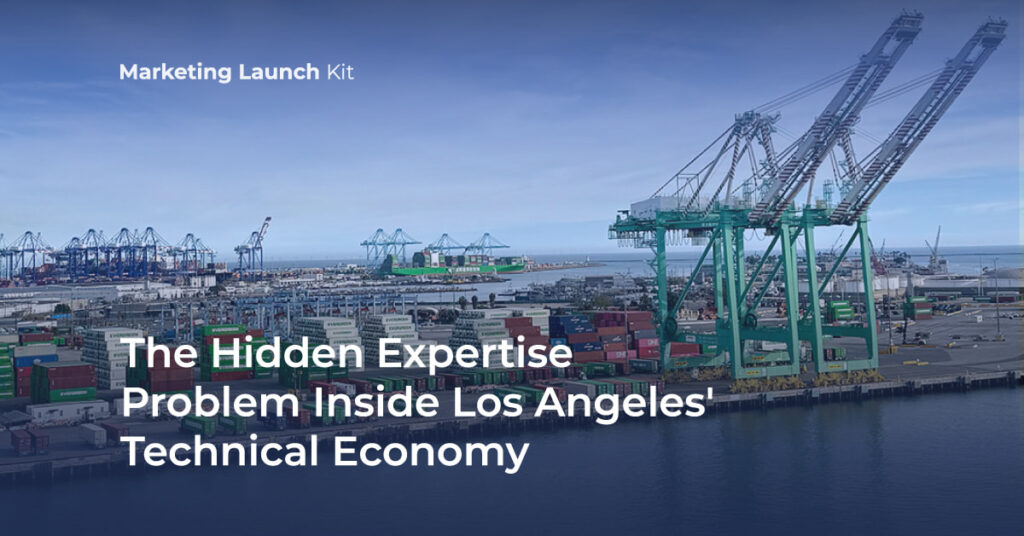
These companies possess valuable engineering knowledge and technical insight, but little of it shifts outward to support how they market and position themselves. This creates a clear hidden expertise problem across Los Angeles’ technical economy.
The Hidden Expertise Problem
The hidden expertise problem occurs when technical companies possess extraordinary internal knowledge, but much of it remains inaccessible to external buyers. When the commercial system doesn’t position the company as credible and experienced, that expertise is never given a real chance.
Hidden expertise also creates several organizational bottlenecks:
- Internal teams rebuild the same explanations from scratch without a central repository for information and collateral
- Engineers explain the same concepts client meeting after client meeting
- Strong project examples never become case studies for potential clients
- Technical knowledge isn’t developed into content for targeted engagements
- Buyer questions are answered during meetings but not turned into reusable sales and marketing resources
Future clients cannot evaluate what they cannot find. Most technical companies do not intentionally carry acquired expertise into their long-term business development strategy. Intellectual capital remains useful internally but is not converted into business assets.
Institutional Knowledge as a Competitive Advantage
Many technical B2B companies compete every day through expertise. Over time, these organizations accumulate a wealth of institutional knowledge that can become one of the company’s greatest competitive advantages.
Peter Drucker coined the term “knowledge worker,” describing the shift of value away from capital and physical machinery toward institutional knowledge and human expertise. Thomas Davenport and Laurence Prusak made a related point: working knowledge that stays locked inside individuals or documents is expertise an organization cannot fully maximize.
APQC has reached a similar conclusion through its research on knowledge as a high-value business asset. NASA built one of the best-known institutional responses to this problem. Its Lessons Learned Information System exists because technical knowledge is often lost through turnover and project transitions, then relearned at significant expense.
Most of this research focuses on internal operations. It does not address what happens when someone tries to evaluate a company from the outside without internal access. This is where the hidden expertise problem lives.
Technical organizations are often exceptional at managing knowledge for internal execution, but far less intentional about managing it for external buyers. They build systems that preserve knowledge for engineering and quality teams without building the equivalent for marketing and business development.
The knowledge management muscle already exists, but it has never been pointed outward. That is where the untapped competitive advantage lies.
Examples of Hidden Expertise in the Los Angeles Technical Economy
Los Angeles has become one of the nation’s most specialized technical economies. In 2025, 38% of all LA venture funding went to aerospace and hard tech companies alone, reflecting both the region’s engineering depth and its growing strategic importance.
As these companies mature, they accumulate valuable technical knowledge and project experience. Yet little of that expertise shifts outward to strengthen how the company is marketed and evaluated. Traditional marketing doesn’t work because buyers need more than visibility. They need evidence of execution, credibility, and technical depth.
This is where many organizations encounter the hidden expertise problem. The following examples show how the hidden expertise problem appears across Los Angeles’ leading technical industries.
Hard Tech & Engineering Startups
Hard tech and engineering startups experience a related problem, but it often begins earlier. Many grow through VC circles, strategic partners, or existing relationships. This creates real momentum and can carry the business through its initial stages.
Many confuse funding momentum with market authority, so PR gets mistaken for marketing and appears like:
- Funding announcements
- Hiring updates
- Contract vehicle awards
- Partnership announcements
These milestones show activity and external validation, but they do not reveal much thought leadership, project experience, or lessons learned.
Behind the scenes, the startup may be doing difficult prototyping, systems integration, manufacturing scale-up, and deployment work. That is the critical part of the business, yet little of it is marketed. The company’s website may look modern, but the information throughout is basic and sparse. The contrast between what the company does and what it shows is stark.
Most engineering startups do not notice this problem until they are expanding outside of the original network. They start pursuing larger commercial clients, prime contractors, or competitive government programs. These decision-makers may have no prior connection to the startup’s early supporters, so they need clear evidence of execution and credibility before the first meeting.
The company may mature into a reputable engineering firm while its public presence stays in early-stage startup mode. Its business development system must mature alongside the organization. Otherwise, winning new business will become increasingly difficult over time.
Aerospace & Defense
An aerospace supplier may complete a multi-year customer engagement involving:
- Design reviews
- First article inspections
- AS9100 and ITAR documentation
- Supplier corrective actions
- Engineering change requests
- Risk assessments
Each phase builds intel around manufacturing efficiency, quality, and program execution. Yet a prospective buyer may visit the company website and find only a general statement such as:
“We provide top precision aerospace manufacturing.”
The disconnect is blatant when years of demonstrated capability are reduced to a single sentence.
Certifications and general capability statements can confirm that a supplier belongs in the category. They do not show the company’s judgment when a program becomes difficult. A buyer still cannot conceptualize how the team:
- Manages changing requirements
- Resolves quality issues
- Prepares for production
- Reduces risk before scaling the program
ITAR and AS9100 requirements create another obstacle. Program data may be sensitive, and customer specifications may be proprietary. Over time, companies begin treating all information as off-limits simply because some of it cannot be shared.
That is black-and-white thinking.
A supplier can demonstrate maturity without exposing controlled information. It can explain how it approaches engineering changes, supplier quality, production readiness, and complex requirements. It can also document outcomes without naming the client or disclosing proprietary details.
Without that proof, the supplier remains dependent on introductions and incumbent relationships. Years of aerospace and defense work should create more than completed programs. They should also create a body of evidence that strengthens the company’s position for the next one.
Port & Logistics
Southern California’s ports move billions of dollars in cargo every year through one of the world’s most complex logistics ecosystems. Companies supporting the Port of Los Angeles and Long Beach develop specialized expertise across:
- Terminal and warehouse operations
- Equipment reliability and asset maintenance
- Freight and inventory systems
- Automation and systems integration
- Throughput and capacity planning
- Regulatory compliance
- Operational process improvement
Each project builds information around how cargo, data, and people move through complex networks, but this isn’t naturally woven into standard marketing or RFP content. Instead, years of operational intelligence remain hidden inside:
- Daily operations
- Maintenance records
- Project reports
- Technical teams’ judgement
When prospects visit the company website, they find broad taglines around “end-to-end logistics solutions” or “innovative transportation services.” The problem is that these statements don’t explain what the company literally does. The buyer still can’t picture the team:
- Responding when terminal delays disrupt downstream logistics
- Improving equipment uptime and maintenance cycles
- Adapting in real time to changing port and warehouse conditions
The company may help operate one of the world’s most important logistics networks while presenting itself externally like any other general service provider. That becomes a setback when it begins pursuing larger industrial opportunities or competitive RFPs.
Buyers need evidence that the company can navigate disruptions, make sound operational decisions, and solve problems like the ones they face. Without that proof, the depth behind the operation remains difficult to gauge.
Digital Business Development
Digital Business Development starts with the assumption that most technical companies hold the expertise required to earn trust. The challenge is organizing that expertise into assets the business can continually reuse and leverage, such as:
- Case studies
- Technical articles
- Whitepapers
- Product and solution pages
- Proposal sections
- Sales presentations
- Email workflows
- Website layouts
Engineers Don’t Have to Become Marketers
Engineers shouldn’t have to become marketers. Their job is understanding technical requirements and solving difficult problems.
The solution doesn’t require engineers to create content from scratch. It’s having a better process for extracting, translating, and structuring what already exists. This can begin with:
- Technical interviews
- Quality documents
- Existing presentations
- Tradeshow material
The Path Forward
Los Angeles built one of the country’s deepest technical economies without building the systems to prove it.
Aerospace suppliers carry years of program execution that never leaves the quality department. Hard tech startups mistake funding announcements for market positioning. Port and logistics operators solve problems most competitors can’t access.
The pattern holds across every sector covered: the expertise is real, but it is publicly hidden. Digital Business Development closes that gap while protecting sensitive information and drawing from the technical knowledge the company already holds.
The opportunity is building a system that translates technical density into buyer-facing material that is legible. For technical companies that are preparing to compete for larger contracts, government programs, or competitive RFPs, the question is if unfamiliar buyers can understand the company before the first meeting.
The expertise already exists inside the company. The next step is building the system that allows buyers to see and evaluate it.
Turning Hidden Expertise into a Business Development System
Marketing Launch Kit builds Engineering Marketing Systems and process design for hard tech, aerospace and defense, and port and logistics companies. Using a consulting-driven approach, the work begins by identifying where opportunities and revenue are leaking, what buyers can’t find, and which gaps are weakening the company’s credibility and market position.
Existing expertise is then turned into buyer-facing assets such as case studies, technical content, and sales collateral. These assets work together to strengthen authority, support larger opportunities, and bring the company’s market position in line with the sophistication of its operations. The outcome is marketing built for technical environments and tied directly to revenue.
Build a Marketing System for Complex Engineering Solutions
Engineering companies don’t need more posts or one-off activities. They need an integrated marketing system that helps technical buyers discover, understand, and trust their expertise.
Marketing Launch Kit provides consulting and implementation services that integrate enterprise website architecture, technical content, product positioning, CRM, lead systems, and analytics into one strategic setup.